Showing posts with label math. Show all posts

Tuesday, September 7, 2021

Representing Math Thinking

Our Statement of Inquiry:
There are many relationships and shared characteristics between systems in the world.

Groups have been tasked to work on several challenging open ended investigations with their team. The main purpose was to introduce some of the big concepts of this math course, such as organizing data and using mathematical reasoning to make predictions.

We are continuing to investigate multiple ways to represent (or show) mathematical ideas.

I love seeing the different ways that students have been representing their ideas using numbers, symbols, diagrams, words, and various kinds of tables.

Student-Created Inquiry Questions:
  • What does this tell me? 
  • How is this changing?


    Wednesday, August 8, 2018

    Notice and Wonderings as a First Day of School Activity


    Mindfulness

    I like to start class with mindfulness because my sixth graders are transitioning into class at different times.

    The classroom lights are turned off, music is playing, there is either the agenda on the board, or a "See, Think, Wonder". Once I notice most of my students have arrived to class, I will start them off doing breathing exercises, or guide them through a positive meditation.


    Luckily I'm at a school that has implemented mindfulness from kindergarten to high-school so most of my students have already had experience with mindfulness.


    Mindfulness will usually last 5-10 minutes depending on what's on for the day.


    Notice and Wonderings
    I will often have a math-related image as a "See, Think, Wonder" or "Notice and Wonder" allowing students to use the initial mindfulness time to make observations.

    After mindfulness, I posed the following questions to the group:


    What did we notice and wonder about this image?"


    Here were some of the students' responses:

    • I noticed that the numbers are increasing clockwise.
    • I noticed that there are multiples of 3 happening.
    • I noticed that there are prime numbers.
    • I noticed that some numbers have the digit of 3.

    As a first day of school activity, I had the following images printed on A3 paper with the following questions:
    • What do we notice and wonder about these pictures?
    • Which picture best represents how you are feeling right now?
    • How you feel about math?
    I placed one image on each group's table and had students rotate through writing their thoughts underneath the picture.

    Some of their thoughts included:
    • Math is complicated like the school of fish.
    • Math is tiring.
    • Math is an endless journey.
    • I am like the young plant. My math knowledge is growing.
    • Math is something we need to strive towards and practice.
    • Math is like a tornado. It is very confusing.


    Monday, June 6, 2016

    Investigating, "Do Taller People Jump Further Than Shorter People?"

    My Grade 2 students investigated and responded to an open-ended problem: "Do Taller People Jump Further Than Shorter People?" 

    This activity gave students the opportunity to use mathematics through the lens of the scientific process. 

    Question
    Students were posed the following question:

    Hypothesis
    Using a visible thinking routine, students were asked to think of "tugs", or reasons why they support a certain side of the question. 


    Hypothesis ranged from a strong yes, to a no, and even yes and no:
    • Yes, taller people jump further I think because they have longer legs. -Izzy
    • Yes, taller people are probably a bit stronger so they can probably jump further. - William
    • It is a no and yes, because I think it depends on how strong you are and how heavy you are. I'll need to find out more before I can say yes or no. - Tony
    • No, because the taller people are heavier so they drop faster so they can't jump as far. - TJ
    • No, because taller people are heavier than shorter people so they won't be able to jump as far. - Aqif
    Learner Profiles
    As a class we discussed what Learner Profiles we should all be mindful of for a successful investigation:
    • Principled - We need to be principled because if we make a jump of 120 cm, we can't say we jumped 150 cm even though no one is looking. - Dan
    • Caring - We shouldn't get mad if we don't get the best jump. We should be caring to others and tell them they did a good job because they tried their best. - Kris
    • Thinker - We will need to be thinkers to know how to use the measuring tape and rulers. - Ben
    • Inquirer - We will need to ask questions and think for ourselves. - Theresa
    • Risk-Taker - You can't be worried about making the best jump and just try your best to jump. - Antonina
    Is it Fair? Experiment
    Students were asked, "What would we need to follow to make sure our investigation is fair?"
    • When you jump, you should measure where the top of your toe lands, not where your hand falls, or the back of your foot. - Paula
    • You need to measure from zero when you use the measuring tape. - Jung Seo
    • You need to stand behind the black line, not on the black line or on top of it. - James
    • You shouldn't run and jump. You need to just stand and jump. - Minh Anh
    • We need to take turns so we don't jump into people's area and ruin their jumps. - An Dan
    Conducted an Experiment
    Our mathematical focus was:
    • Compare, order, and describe objects by various measurable attributes for length
    • Select and use appropriate tools and units to measure length
    Students carried out tests by jumping and measured the length of their jump using centimeter/meter rulers.


    Analyzed the Results & Made a Conclusion
    Students shared their results and some changed their position on the "Yes" and "No" continuum of our original hypothesis.
    • No, Dong Jae is shorter than Nhat Anh, but he jumped further. Paula is very tall, but she made the smallest jump.
    • Yes and no because Dong Jae is shorter than Nhat Anh, but if Dong Jae was gone then you can see Nhat Anh jumped further than Aqif and Dan jumped further than Minh Anh and they are both taller. There is a pattern that answers yes, but there are also patterns that answer no.


    As a class we brainstormed other questions we could investigate. Students then worked in groups to come up with their own mathematical experiment. 


    Monday, May 23, 2016

    Math is Everywhere...Even in Stories

    My students were posed the following statement:
    Math is Everywhere...Even in Stories. Do you agree or disagree? Find Evidence.

    See, Think, and Wonder
    We watched the story, "Moira's Birthday" by Robert Munsch and students were asked to "see, think, and wonder" if math was present in the story. 


    Investigate
    Through the use of a story, students were provided a context to solve an open-ended question.


    In groups, they worked together to investigate and show evidence of their thinking.


    Marketplace Cooperative Sharing Strategy
    Taking turns, half of the group "Marketplaced" their knowledge by presenting the strategies they used to solve the problem, while the other half reflected and provided comments on the groups' use of their strategies. 


    Monday, May 2, 2016

    What's the Big Idea?

    Our Big Idea in Math
    "Decimals, fractions, and percentages can be represented in a number of ways that have the same value."

    Investigate
    Second graders investigated this question:


    Prove It & Show Evidence


    Monday, April 4, 2016

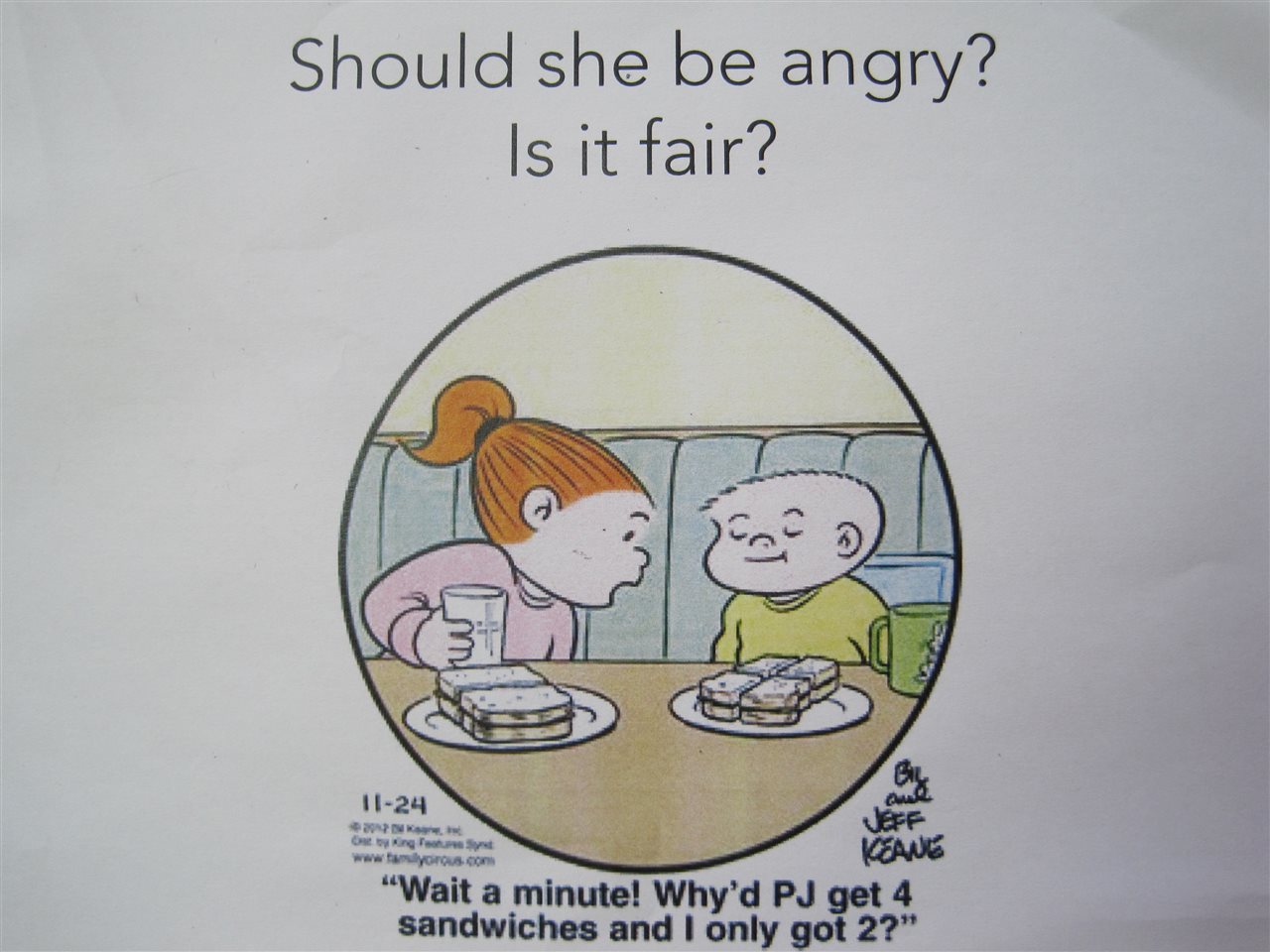
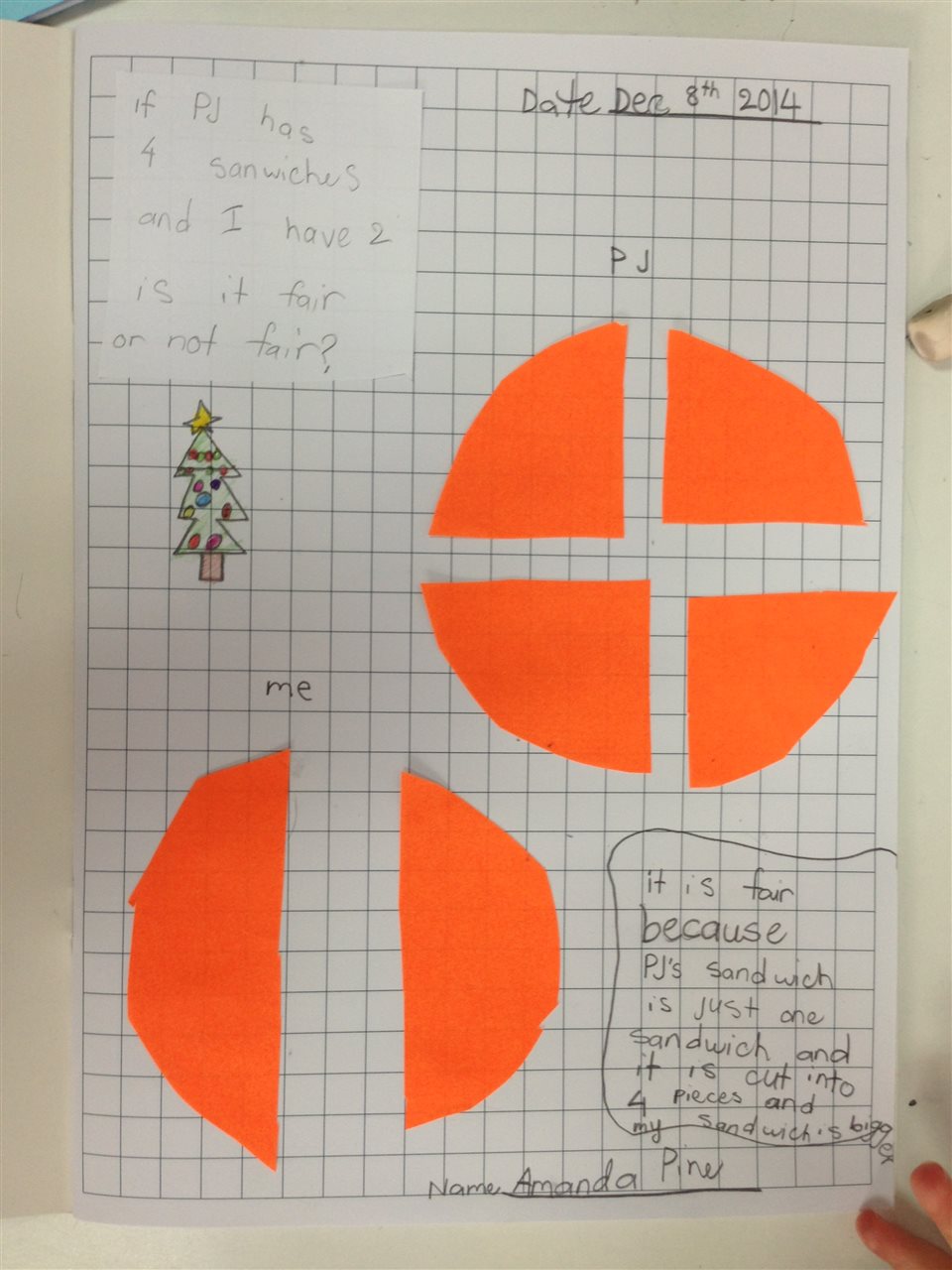
    Confused with Fractions...Great!

    We started with the question: 
    What comes to your mind when you think of the word fraction, decimal, and percent?

    Using their prior knowledge, students generated their ideas through words and pictures. 
    • "I've seen decimals and percents in the store." - Dong Jae
    • "I remember getting 100% on a test." - TJ
    • "I think fractions are sharing because I played a game on the computer one time called Fractions Pizza and I had to share the pizzas in the restaurant." - Minh Thu
    Figure It Out
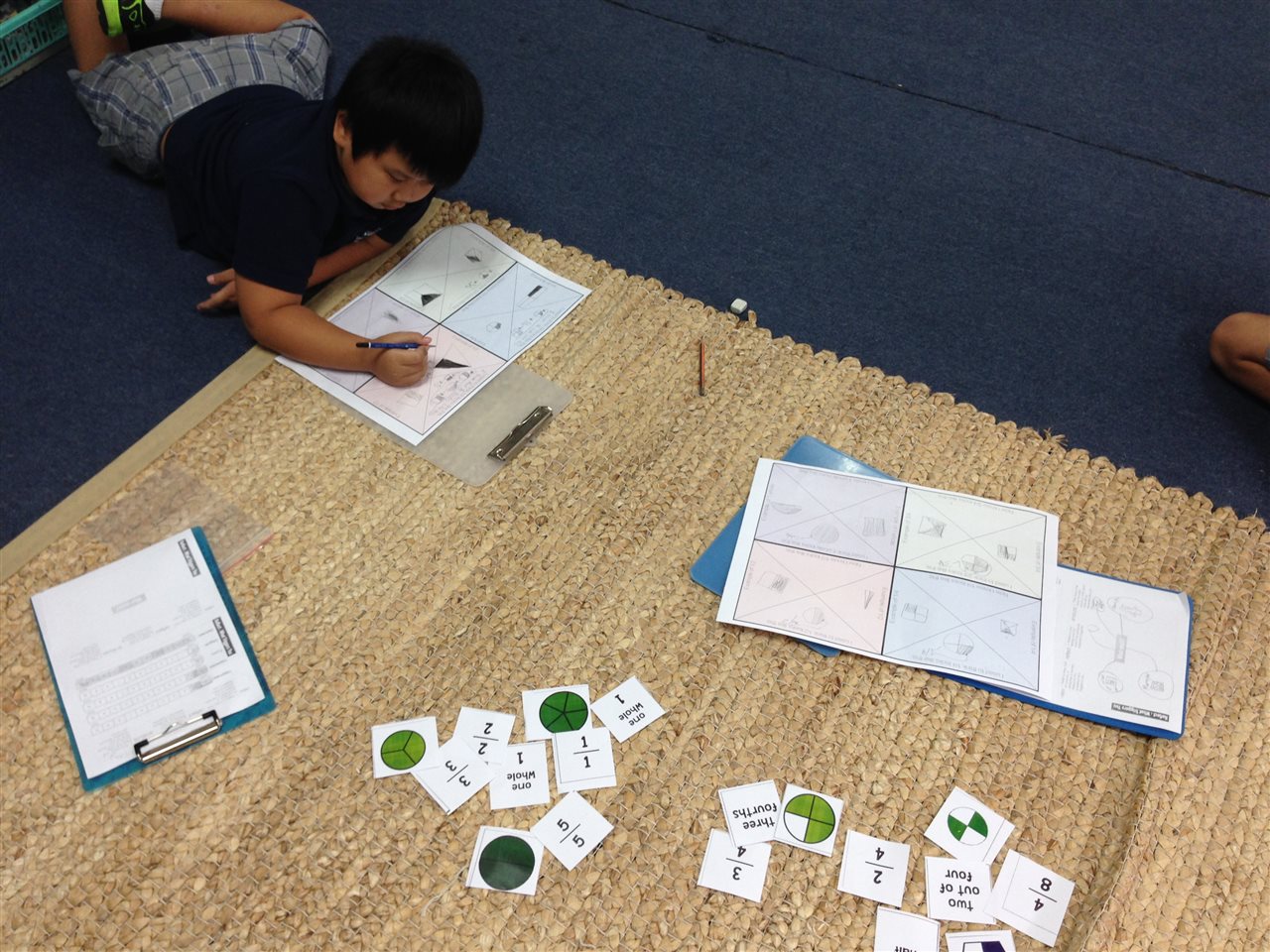
    Students were engaged in a fractions, decimals, and percents provocation designed to create confusion. They were tasked to look for connections and similarities or differences between the three. 


    During this learning process, students worked on their group decision making skills and had to justify why certain sorts should go together. 


    Reflect and Connect
    Students reflected on the patterns they noticed between the three and were asked to make connections to create their own understanding using the visible thinking routine: "I used to think, but now I know..."


    Monday, March 7, 2016

    Weight a Minute!

    This week my students continued working towards becoming "Masters of Measurement" through investigations exploring the weight of items.

    One group looked at real life items that we buy in shops and identified the weight of each item using grams and kilograms and then sorted them from lightest to heaviest.


    Another group completed a weight scavenger hunt by searching around the classroom for items that had a certain criteria e.g. two items that weighed together are more than 1 kilogram but less than 2 kilograms.


    Another group worked on problem solving an open ended question relating to measurement. 


    School to Home Challenge. Students were asked to follow up on their learning by blogging their response to the following questions:
    • Imagine you had to measure the length, width and weight of a wild tiger. Which would be the hardest to measure and why? Rank the ways of measuring in order of difficulty. e.g. 1) Length - most difficult because...
    • Can you find 5 items in your home that have grams and kilograms written on them?
    • What was easy or tricky when you were completing the scavenger hunt?