Showing posts with label inquiry. Show all posts

Monday, June 6, 2016

Investigating, "Do Taller People Jump Further Than Shorter People?"

My Grade 2 students investigated and responded to an open-ended problem: "Do Taller People Jump Further Than Shorter People?" 

This activity gave students the opportunity to use mathematics through the lens of the scientific process. 

Question
Students were posed the following question:

Hypothesis
Using a visible thinking routine, students were asked to think of "tugs", or reasons why they support a certain side of the question. 


Hypothesis ranged from a strong yes, to a no, and even yes and no:
  • Yes, taller people jump further I think because they have longer legs. -Izzy
  • Yes, taller people are probably a bit stronger so they can probably jump further. - William
  • It is a no and yes, because I think it depends on how strong you are and how heavy you are. I'll need to find out more before I can say yes or no. - Tony
  • No, because the taller people are heavier so they drop faster so they can't jump as far. - TJ
  • No, because taller people are heavier than shorter people so they won't be able to jump as far. - Aqif
Learner Profiles
As a class we discussed what Learner Profiles we should all be mindful of for a successful investigation:
  • Principled - We need to be principled because if we make a jump of 120 cm, we can't say we jumped 150 cm even though no one is looking. - Dan
  • Caring - We shouldn't get mad if we don't get the best jump. We should be caring to others and tell them they did a good job because they tried their best. - Kris
  • Thinker - We will need to be thinkers to know how to use the measuring tape and rulers. - Ben
  • Inquirer - We will need to ask questions and think for ourselves. - Theresa
  • Risk-Taker - You can't be worried about making the best jump and just try your best to jump. - Antonina
Is it Fair? Experiment
Students were asked, "What would we need to follow to make sure our investigation is fair?"
  • When you jump, you should measure where the top of your toe lands, not where your hand falls, or the back of your foot. - Paula
  • You need to measure from zero when you use the measuring tape. - Jung Seo
  • You need to stand behind the black line, not on the black line or on top of it. - James
  • You shouldn't run and jump. You need to just stand and jump. - Minh Anh
  • We need to take turns so we don't jump into people's area and ruin their jumps. - An Dan
Conducted an Experiment
Our mathematical focus was:
  • Compare, order, and describe objects by various measurable attributes for length
  • Select and use appropriate tools and units to measure length
Students carried out tests by jumping and measured the length of their jump using centimeter/meter rulers.


Analyzed the Results & Made a Conclusion
Students shared their results and some changed their position on the "Yes" and "No" continuum of our original hypothesis.
  • No, Dong Jae is shorter than Nhat Anh, but he jumped further. Paula is very tall, but she made the smallest jump.
  • Yes and no because Dong Jae is shorter than Nhat Anh, but if Dong Jae was gone then you can see Nhat Anh jumped further than Aqif and Dan jumped further than Minh Anh and they are both taller. There is a pattern that answers yes, but there are also patterns that answer no.


As a class we brainstormed other questions we could investigate. Students then worked in groups to come up with their own mathematical experiment. 


Monday, April 25, 2016

The Pursuit of Curiosity


With Einstein's advice in mind, we thought about how we could use our students' interests and curiosities to initiate learning.

It all started with getting our students to ask questions and to get used to the idea of catching and jotting down any thoughts they had in their mini notebooks or on a Post-it:


We began the conversation with our students by showing curiosity-boosting videos, such as Caine's Arcade and asking:
  • What do you want to learn more about?
  • What makes you curious?
Students had to think about things they were really into and start a "Heart Map" of passions to explore. 


Then they made a plan on how to gather more information based around their curiosities and passions. A structure was provided to help guide them in their inquiries, but they ultimately decided what questions or passions to explore, and will eventually determine how to share what they have learned.


During this process, students:
  • Worked on their research skills
  • Browsed the library shelves and learned to use the Dewey Decimal system to gather books about their passion
  • Read nonfiction text and used web resources and videos to further their knowledge
  • Developed more questions as their inquiry progressed
  • Worked on "cave boy/girl" note taking skills by writing down notes in their notebooks

Here's a sampling of student curiosities: 
  • Izzy and Theresa have hooked onto the topic of salons and hair dressing, specifically exploring a variety of hairstyles and how to recreate them. 
  • Paula's interested in learning more about why people start wars. She's inquiring into World War II. 
  • Dan was really motivated after watching, "Caine's Arcade," he's decided to look into the many uses of cardboard and is researching ideas on what to make with cardboard. 
  • Amanda's into art and crafts, so she's checked out books about crafting and is now working on a project to do with photo frames and flowers.
  • From our last unit, we looked at how the Egyptians used obelisk to measure time. Minh Thu was really excited to further her curiosity of Egypt. With Ms. Sophie, the librarian's help, she was able to find a second-grade friendly book on Egypt. 
Our next steps will probably include:
  • Having students share through a curiosity gallery. 
  • Improve self-motivation for learning by incorporating curiosity-driven learning into their homework


Monday, April 4, 2016

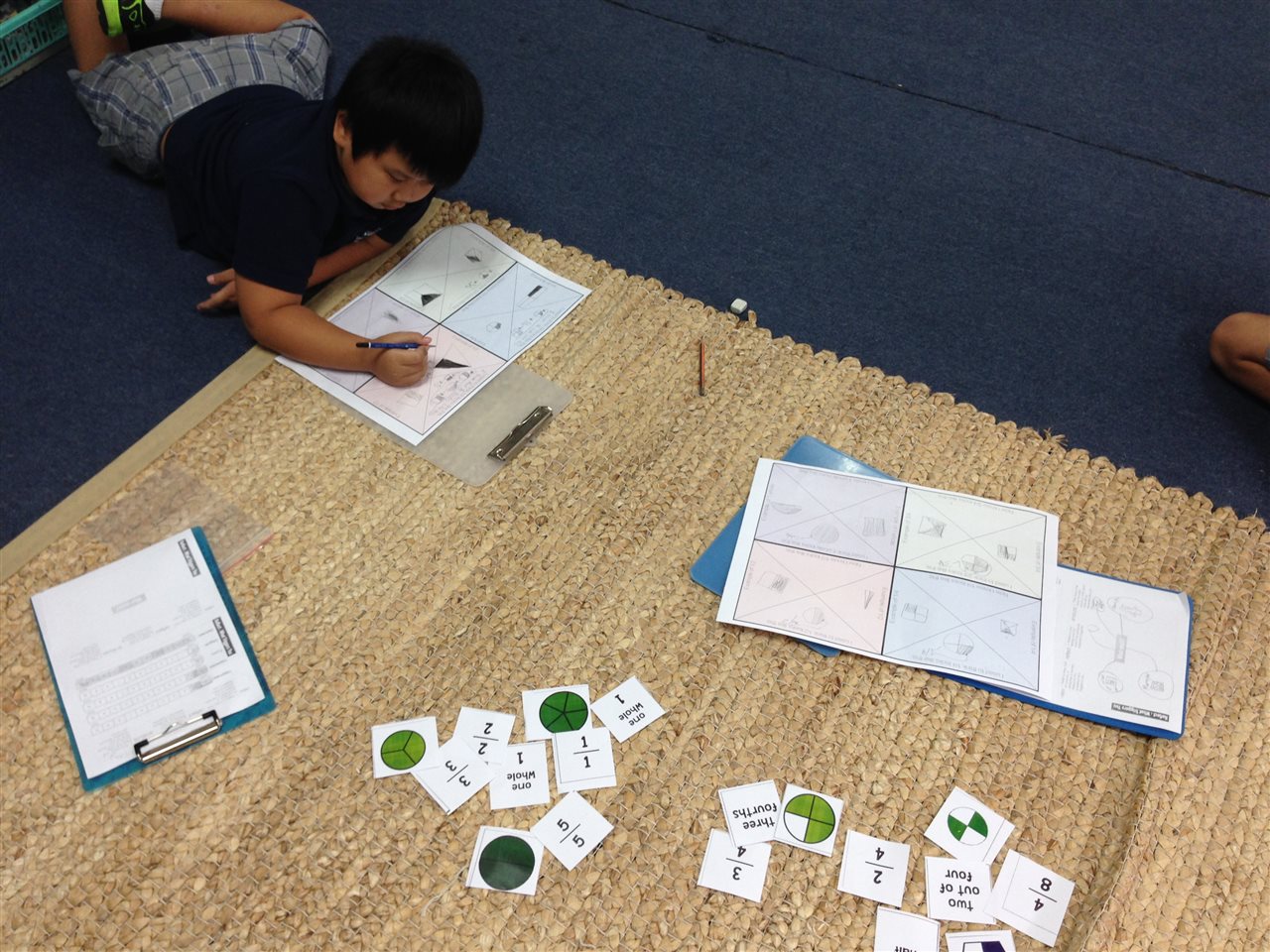
Confused with Fractions...Great!

We started with the question: 
What comes to your mind when you think of the word fraction, decimal, and percent?

Using their prior knowledge, students generated their ideas through words and pictures. 
  • "I've seen decimals and percents in the store." - Dong Jae
  • "I remember getting 100% on a test." - TJ
  • "I think fractions are sharing because I played a game on the computer one time called Fractions Pizza and I had to share the pizzas in the restaurant." - Minh Thu
Figure It Out
Students were engaged in a fractions, decimals, and percents provocation designed to create confusion. They were tasked to look for connections and similarities or differences between the three. 


During this learning process, students worked on their group decision making skills and had to justify why certain sorts should go together. 


Reflect and Connect
Students reflected on the patterns they noticed between the three and were asked to make connections to create their own understanding using the visible thinking routine: "I used to think, but now I know..."


Monday, February 29, 2016

Student Driven Questions

How might students be encouraged to inquire about the world around them and follow up on their own questions?

My students are learning the importance of asking questions. We explored what makes up a thick or thin question. We started with their own wonderings as the starting point and asked: "Which questions make you think more? think less?" By comparing the types of questions and answers, students were able to conclude the following:

Thick Questions:
  • Hard to answer
  • Takes time to think about 
  • There may be many answers to the same question and oftentimes there may never even be an answer
  • Cannot be answered with just a "yes" or "no"
Thin Questions
  • Fast and easy to answer 
  • Answers can usually be found quite easily and right away
  • There is usually only one answer
  • Can usually be answered with a "yes" or "no"
Wonder


Students sorted their questions into thin or thick questions that were connected to our unit or not connected to our unit. Some felt their questions were really thin (Who invented the toilet?) so they placed their Post-its near the top, others felt they weren't so thin, but still thin nonetheless (What makes snow?) so they decided to place it near the middle. Others thought their questions were really thick (Is God real?) so they placed those on the bottom.
Student wonderings included:
  • Why do we have time? - Dae Heon
  • How does time control the world? - Theresa
  • I wonder why time can see everything. - Ben
  • How old is the Great Wall of China? - Isabella
  • When do turtles die? - Minh Thu & Gabby
  • Who invented war? - Dan
  • How does the Earth move? - Aqif
Investigate
Students and I collected their research using a website called Blendspace. This allows for personalization and differentiation of resources for each student to investigate their inquiries.


With the iPads, each student can scan their own QR code, which takes them to their own Blendspace of inquiry resources.


Making and Sharing Conclusions
Students then decide when to conclude their investigations and take part in sharing their findings with their classmates. 


This process has allowed my students to pay more attention to their own thinking, while giving them the tools to research what they're wondering and interested in.

Friday, October 30, 2015

Bedrooms Around the World

Central Idea: 
Learning about similarities and differences between cultures can help us understand ourselves. 

Lines of Inquiry: 
  • Similarities and differences within and between cultures 
  • How to investigate cultures 
  • How our thinking about 'others' can change 

Learner Profile: Open-minded, Reflective 
Attitudes: Respect, Appreciation, Curiosity

During this unit, my second graders and I have learned that everyone has a culture and that culture shapes how we see the world, ourselves, and others. 

We started off recognizing the aspects of culture that are most visible, such as food, language, and clothing, but now we're recognizing that others are not as visible, such as our values, assumptions, and priorities.

Children have been exploring how our interaction with the environment and others shapes one's culture. 

One of the activities has been to look at the similarities and differences of children's bedrooms around the world. Children sorted the bedrooms into their own categories like: Beautiful/Not Beautiful, Poor/Not Poor, Toys/No Toys, Clean/Dirty, Comfortable/Not Comfortable.

I asked my students to continue the conversation at home with these questions:

  • What photographs interested or surprised you most? Why? 
  • What questions did those photos raise for you? 
  • What can these photos tell you about the lives of the people pictured? 
  • What do you think they can’t tell you?

Some rather insightful comments have come up because of this activity: 
  • "It doesn't seem fair that we have such nice bedrooms just because our families have money." 
  • "I would be very sad if I had that bedroom."
  • "Why do some children have more or less than others?"
  • "I'm lucky to be born into my family."
  • "What if I was that child?"
  • "I think having too much in your bedroom or too much stuff in your house doesn't make someone happy. Just because some of the bedrooms don't have much it doesn't mean that those kids are not good or that we are better."