Monday, March 7, 2016

Weight a Minute!

This week my students continued working towards becoming "Masters of Measurement" through investigations exploring the weight of items.

One group looked at real life items that we buy in shops and identified the weight of each item using grams and kilograms and then sorted them from lightest to heaviest.


Another group completed a weight scavenger hunt by searching around the classroom for items that had a certain criteria e.g. two items that weighed together are more than 1 kilogram but less than 2 kilograms.


Another group worked on problem solving an open ended question relating to measurement. 


School to Home Challenge. Students were asked to follow up on their learning by blogging their response to the following questions:
  • Imagine you had to measure the length, width and weight of a wild tiger. Which would be the hardest to measure and why? Rank the ways of measuring in order of difficulty. e.g. 1) Length - most difficult because...
  • Can you find 5 items in your home that have grams and kilograms written on them?
  • What was easy or tricky when you were completing the scavenger hunt?


Wednesday, March 2, 2016

Tessellations

Students were posed the following inquiry:

Regular tessellations (1) use identical regular polygons (2) to fill a space. The vertices (corners) of each polygon must match up with the vertices of other polygons.
You can produce exactly three regular tessellations:


Can you convince yourself that there are no more?


Test your ideas on this website: http://nrich.maths.org/content/id/4832/polygons.swf  


NOTE:
  1. A tessellation is a pattern made of identical shapes:
    • the shapes must fit together without any gaps
    • the shapes should not overlap
  2. Polygons are (2D) shapes with straight sides. To be a regular polygon all the sides and angles must be the same, eg. square, hexagon, pentagon.


Here are the students hard at work:


Monday, February 29, 2016

Student Driven Questions

How might students be encouraged to inquire about the world around them and follow up on their own questions?

My students are learning the importance of asking questions. We explored what makes up a thick or thin question. We started with their own wonderings as the starting point and asked: "Which questions make you think more? think less?" By comparing the types of questions and answers, students were able to conclude the following:

Thick Questions:
  • Hard to answer
  • Takes time to think about 
  • There may be many answers to the same question and oftentimes there may never even be an answer
  • Cannot be answered with just a "yes" or "no"
Thin Questions
  • Fast and easy to answer 
  • Answers can usually be found quite easily and right away
  • There is usually only one answer
  • Can usually be answered with a "yes" or "no"
Wonder


Students sorted their questions into thin or thick questions that were connected to our unit or not connected to our unit. Some felt their questions were really thin (Who invented the toilet?) so they placed their Post-its near the top, others felt they weren't so thin, but still thin nonetheless (What makes snow?) so they decided to place it near the middle. Others thought their questions were really thick (Is God real?) so they placed those on the bottom.
Student wonderings included:
  • Why do we have time? - Dae Heon
  • How does time control the world? - Theresa
  • I wonder why time can see everything. - Ben
  • How old is the Great Wall of China? - Isabella
  • When do turtles die? - Minh Thu & Gabby
  • Who invented war? - Dan
  • How does the Earth move? - Aqif
Investigate
Students and I collected their research using a website called Blendspace. This allows for personalization and differentiation of resources for each student to investigate their inquiries.


With the iPads, each student can scan their own QR code, which takes them to their own Blendspace of inquiry resources.


Making and Sharing Conclusions
Students then decide when to conclude their investigations and take part in sharing their findings with their classmates. 


This process has allowed my students to pay more attention to their own thinking, while giving them the tools to research what they're wondering and interested in.

Monday, February 22, 2016

Inquiry Through Authentic Maths Problem

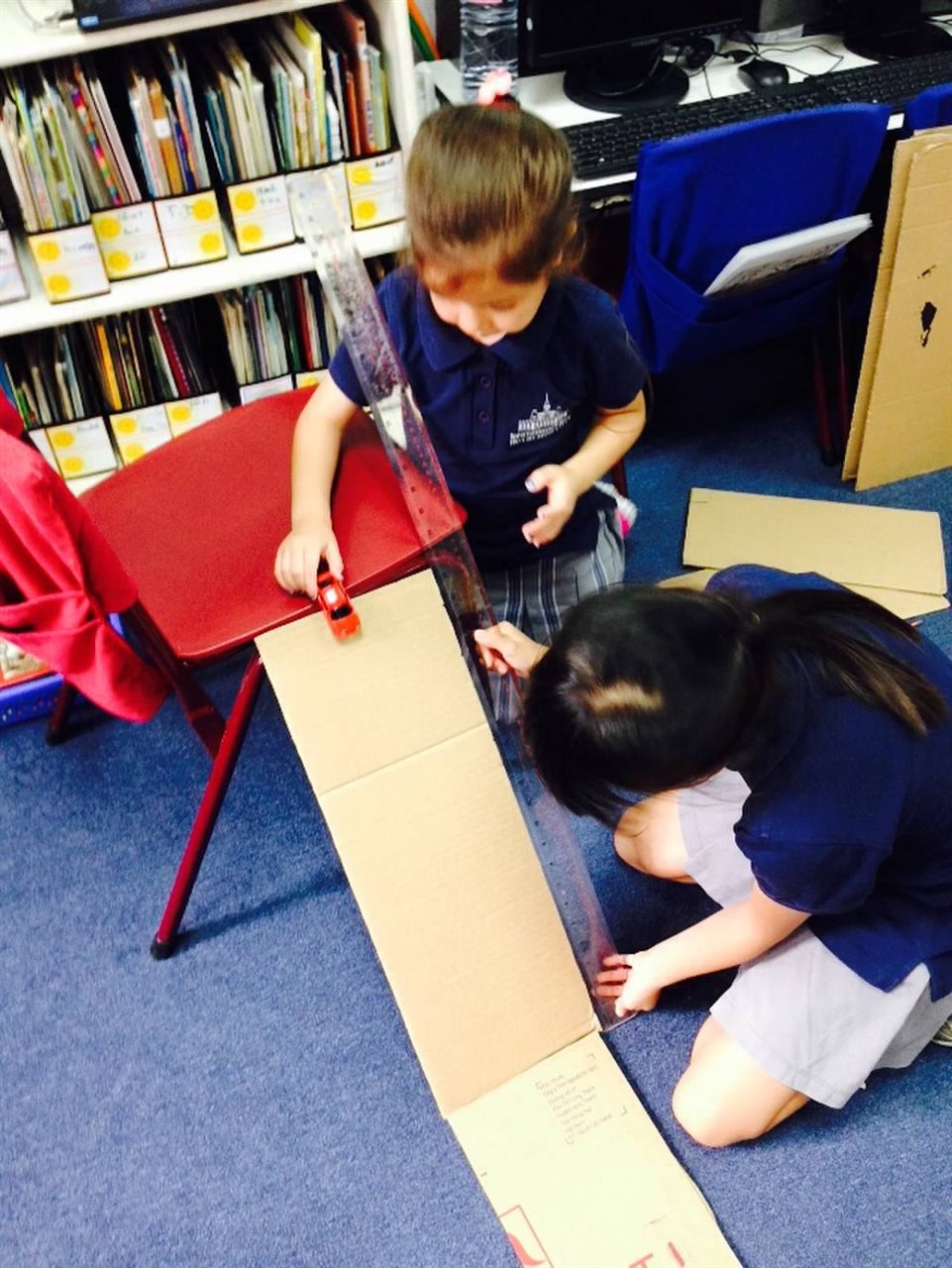
Grade 2 students investigated and responded to an open-ended problem one could encounter in 'real' life: ramps. 

This activity gave students the opportunity to use mathematics through the lens of the scientific process. 


Step 1: Question
Students were posed the following questions:


Step 2: Hypothesis
Students gave their best guess:

Hypothesis 1
When the ramp is really high, you use up the speed going down so you don’t travel further, you actually stop. It is kind of like falling from a building.

Hypothesis 2
The higher you get, the more gravity you have, so the faster you can go down the ramp, which means you can go further.

Hypothesis 3
The lower the ramp is, then the speed won't be so fast so you're not going to go as far.

Step 3: Conducted an Experiment
Our mathematical focus was:
  • Compare, order, and describe objects by various measurable attributes for length
  • Select and use appropriate tools and units to measure length
  • Use non-standard units to measure
Students carried out tests with different ramp heights and measured the height of the ramp using centimeter/meter rulers and non-standard units (cubes, hands, blocks, etc.), including the distance the car traveled. 
Some questions that came up during the experiment were:
  • Do we measure from the top of the ramp or the end of the ramp?
  • When we use the ruler do we start on the zero or the one?
  • How can we change the ramp to make the car go faster or further?


Step 4: Analyzed the Results & Made a Conclusion
Students shared their results and most changed their position on the "Yes" and "No" continuum of our original hypothesis. 

Their conclusions were:
  • It goes more far when it isn't on carpet.
  • The shorter ramps made the car go further. 
  • The longer ramps made the car go shorter. I think it's because the car used up all its power to travel on the ramp.
  • I chose a heavier car and it made it go further. The light car didn't go as far. 


Monday, February 15, 2016

Constructing Knowledge

This week 2C and 2D have been constructing their own knowledge, the question we kept in mind when planning was 'How can we enable deeper thinking and learning?'.

The students engaged in the following tasks and activities as part of our Unit of Inquiry. Rather than the teacher taking centre stage, students worked together with a partner to inquire and understand the four science topics through these student questions:
  • What causes seasons?
  • What causes changes in the moon?
  • Why do we have day and night?
  • Why do we have time zones?

Some skills the students were using were:
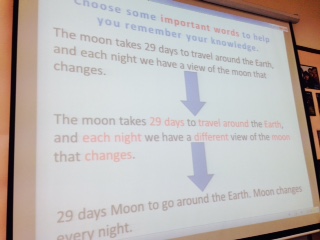
  • note taking
  • reflecting on information on whether it was 'trash' or 'treasure' and could answer the question they were inquiring about.
  • group decision making skills
  • visual interpretation of information
  • analysing digital and print resources and deciding what information to extract
Note-taking Introduction and Practice


Using digital media


Using Print resources


Once students collected and constructed their knowledge in their inquiry journals, they engaged in a marketplace where they shared their knowledge with other students.